
Signs You Need Full Mouth Rehabilitation
Table of Contents
- What Full Mouth Rehabilitation Actually Means
- 10 Signs You Need Full Mouth Rehabilitation
- Full Mouth Rehabilitation Procedure Steps
- Full Mouth Reconstruction Cost and Insurance Coverage
- Recovery Time for Full Mouth Reconstruction
- The Psychological Impact of Restoring Your Smile
- Frequently Asked Questions
Last Updated: August 15, 2026
What Full Mouth Rehabilitation Actually Means
Full mouth rehabilitation is a comprehensive, coordinated series of dental treatments designed to restore the function, health, and appearance of every tooth in the mouth simultaneously. It addresses the entire bite system: the teeth, gums, jaw joints, and supporting bone structure.
Unlike routine dental care, full mouth rehabilitation may include dental implants, porcelain crowns, veneers, dental bridges, periodontal therapy, and occlusal adjustments as part of a single, sequenced treatment plan. The goal is to rebuild a mouth that works correctly, not just looks better.
At Sendero Dental Studio, the team sees patients who have spent years managing symptoms individually, never quite solving the underlying problem. Full mouth rehabilitation identifies root causes of dental breakdown and corrects them systematically, so results last.
Restorative dentistry focuses on repairing function: replacing missing teeth, correcting bite alignment, treating periodontal disease. Cosmetic dentistry focuses on aesthetics. Full mouth rehabilitation typically involves both, because severe dental damage rarely affects function without affecting appearance.
10 Signs You Need Full Mouth Rehabilitation
Most people don’t arrive at a full mouth reconstruction consultation after a single bad dental appointment. The signs accumulate over months or years, often dismissed as minor annoyances.
Here are the ten clearest indicators that your oral health needs more than routine maintenance:
- Chronic jaw pain or soreness that doesn’t resolve with rest or over-the-counter pain relief
- Clicking, popping, or locking of the jaw when opening or closing your mouth
- Multiple missing teeth or teeth that have been extracted and not replaced
- Severe tooth decay affecting several teeth at once
- Significant enamel erosion from acid reflux, diet, or bruxism
- Cracked, chipped, or broken teeth across multiple areas of the mouth
- Difficulty chewing that causes you to avoid certain foods
- Noticeable changes in your bite or the way your upper and lower teeth meet
- Frequent headaches that originate at the temples or jaw
- Speech changes such as lisping or difficulty pronouncing certain sounds
If three or more of these apply to you, a comprehensive oral health assessment is warranted. Multiple signs together almost always indicate a systemic problem with the bite or bone structure.
Chronic Pain, Jaw Soreness, and TMJ Symptoms
Temporomandibular joint disorder is one of the most commonly overlooked drivers of full mouth rehabilitation. When the TMJ is under chronic stress from a misaligned bite or habitual teeth grinding, the effects spread far beyond the jaw itself.
Patients often report persistent headaches, neck tension, ear pain, and facial soreness before connecting those symptoms to their teeth. Bruxism accelerates enamel erosion and puts enormous pressure on the TMJ. Over time, the occlusal vertical dimension, the measured height of the face when teeth are together, can collapse as worn teeth lose their original height, changing the entire relationship between upper and lower jaw.
TMJ symptoms rarely improve on their own. Without correcting the underlying bite problem, even well-made restorations will fail prematurely. Full mouth rehabilitation addresses the TMJ as a structural priority.
Severe Tooth Decay, Enamel Erosion, and Missing Teeth
Tooth decay becomes a full mouth rehabilitation issue when it’s widespread rather than isolated. Decay affecting the majority of the mouth, combined with enamel erosion and missing teeth, creates a cascade of problems that no single procedure can solve.
Enamel erosion from acid exposure strips the protective outer layer of teeth and leaves them vulnerable to sensitivity, fracture, and accelerated decay. Once enamel is gone, it doesn’t regenerate. The only path forward is restorative coverage with porcelain crowns, veneers, or onlays.
Missing teeth compound the problem. When a tooth is lost and not replaced, neighboring teeth drift into the gap, altering the bite and creating new areas of uneven pressure. Bone loss at the extraction site follows within months. Dental implants and bridges must be planned within a comprehensive treatment framework to work correctly together.
Chewing Difficulty, Speech Impairment, and Bite Problems
Chewing difficulty is more than an inconvenience. When patients avoid hard or fibrous foods because eating is painful, nutritional intake changes and jaw muscles weaken from disuse. Malocclusion, a misaligned bite, frequently results from missing teeth, poorly fitted restorations, jaw growth discrepancies, or years of untreated bruxism.
Speech impairment is a real consequence of severe dental damage. Missing front teeth, collapsed bite height, or ill-fitting dental prosthetics all affect how air and sound move through the mouth. Patients sometimes describe a sudden lisp or difficulty with certain consonants after losing teeth or having old restorations fail.
Correcting bite alignment is one of the most technically demanding aspects of full mouth rehabilitation. The restorative team must rebuild teeth to a carefully calculated occlusal vertical dimension, ensuring every new restoration works in harmony with the jaw joints and surrounding musculature.
Never attempt to manage bite pain long-term with over-the-counter mouthguards alone. While they may reduce bruxism damage temporarily, they don’t correct the underlying malocclusion. Delaying proper treatment allows bone loss and joint deterioration to progress, making eventual rehabilitation more complex and costly.
Full Mouth Rehabilitation Procedure Steps
Full mouth rehabilitation is not a single appointment. It’s a sequenced treatment process that can span several months to over a year, depending on case complexity.
Oral Health Assessment and Diagnostic Technology
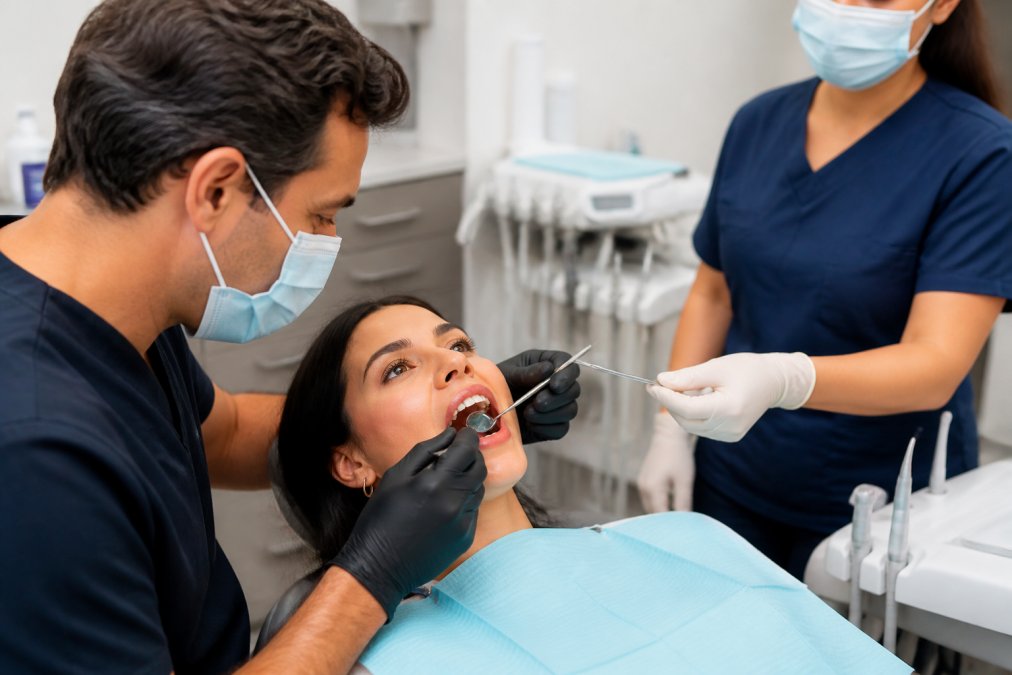
The process begins with a thorough oral health assessment far more detailed than a standard check-up. The dentist evaluates every tooth, gum and bone health, TMJ position and function, and current occlusal vertical dimension.
Modern diagnostic technology plays a significant role. Digital X-rays provide detailed images with minimal radiation. Cone beam computed tomography creates three-dimensional images of the jaw essential for implant planning and assessing bone volume. Intraoral cameras allow both clinician and patient to see problem areas clearly, supporting transparent treatment discussions.
According to the American Dental Association’s clinical resources, a comprehensive oral evaluation is the foundation of any complex restorative case. Some practices also use digital bite analysis tools that measure force distribution across teeth, identifying areas of excessive pressure that X-rays alone can’t reveal.
Building Your Treatment Plan
Once diagnostics are complete, the dentist builds a sequenced treatment plan. Different problems must be addressed in a specific order: you can’t place dental implants into a mouth with active periodontal disease, and you can’t finalize crown heights without first stabilizing the TMJ.
A typical treatment sequence follows this general order:
| Phase | Focus | Common Procedures |
|---|---|---|
| Phase 1: Foundation | Eliminate active disease | Periodontal therapy, extractions, infection treatment |
| Phase 2: Structure | Replace missing teeth, stabilize bite | Dental implants, bone grafting, temporary restorations |
| Phase 3: Restoration | Rebuild function and aesthetics | Porcelain crowns, veneers, dental bridges |
| Phase 4: Refinement | Fine-tune occlusion and appearance | Bite adjustment, final polishing, whitening |
The treatment plan should be presented in writing with each phase explained clearly. Patients should feel comfortable asking why each procedure is sequenced the way it is.
Ask your dentist to show you a diagnostic wax-up before committing to the full plan. This physical or digital model shows what your teeth will look like after treatment, letting you preview the outcome and confirm the proposed bite height feels natural before any irreversible work begins.
Restorative and Cosmetic Phase
The restorative and cosmetic phase is where the visible transformation occurs. This may involve placing dental implants to replace missing teeth, fitting porcelain crowns over damaged teeth, applying veneers to restore front teeth appearance, and fitting dental bridges across gaps.
Porcelain crowns and veneers are matched to natural tooth color and shaped to the planned occlusal vertical dimension. This precision matters: a crown that’s even slightly too tall will alter the bite and stress the TMJ. For patients with significant bone loss, full-arch restoration options such as implant-supported bridges may be recommended over individual implants.
Full Mouth Reconstruction Cost and Insurance Coverage
Full mouth reconstruction cost varies considerably based on the number of teeth involved, specific procedures required, and materials used. The team at Sendero Dental Studio will provide a detailed cost breakdown as part of treatment planning.
Dental insurance plans typically separate restorative procedures from cosmetic ones. Treatments with a clear functional purpose, such as dental implants to replace missing teeth or porcelain crowns on structurally compromised teeth, may attract partial coverage. Purely cosmetic procedures are usually excluded.
The American Dental Association’s guide to dental insurance recommends requesting a pre-authorization from your insurer before beginning treatment. For patients without dental insurance, many dental offices offer phased treatment approaches that spread the financial commitment across the treatment timeline. Sendero Dental Studio offers an uninsured patient special.
The most important financial step before starting full mouth rehabilitation is requesting a pre-authorization from your dental insurer and a written treatment cost estimate from your dentist. These two documents give you a clear picture of your out-of-pocket commitment before any irreversible work begins.
Recovery Time for Full Mouth Reconstruction
Recovery time depends heavily on which procedures are involved. A patient receiving porcelain crowns on existing teeth will experience a very different recovery than someone who has undergone multiple implant placements and bone grafting.
As a general framework:
- After periodontal therapy: Gum tenderness typically resolves within one to two weeks. Full tissue healing takes several months, which is why implant placement is usually delayed until this phase is complete.
- After dental implant placement: The implant integrates with the jawbone over three to six months. During this time, temporary restorations are worn. Most patients manage normal daily activities within a few days of surgery.
- After crown or bridge placement: Sensitivity to temperature and pressure is common for the first few weeks and usually settles as the bite is refined.
- Overall treatment timeline: Complex full mouth rehabilitation cases commonly take twelve to eighteen months from the first appointment to final restorations.
According to the American Academy of Periodontology’s patient resources, bone grafting procedures add significant healing time to implant cases and should be factored into the overall timeline from the start. Rushing the healing phases is one of the most common reasons implants fail.
Post-treatment maintenance is not optional. Patients who complete full mouth rehabilitation should expect more frequent hygiene appointments in the first year, typically every three to four months.
The Psychological Impact of Restoring Your Smile
Severe dental damage carries a psychological weight that’s easy to underestimate. Many patients who need full mouth rehabilitation have spent years hiding their smile, avoiding photographs, or declining social situations where their teeth might be noticed. Chronic oral pain affects concentration, sleep quality, and mood.
The relationship between oral health and overall well-being is documented in research published by the National Institutes of Health, which has examined how dental pain and tooth loss affect self-reported quality of life. The psychological shift after successful rehabilitation is often described by patients as disproportionate to the physical change. Eating without pain, speaking clearly, and smiling without self-consciousness change daily life in ways that go well beyond aesthetics.
A common mistake is underestimating how much anticipation of treatment contributes to anxiety. In practice, the phased approach of full mouth rehabilitation means each appointment has a defined, manageable goal. The process is incremental, not all-at-once.
Patients who understand the timeline, feel comfortable asking questions, and trust their dental team tend to follow through with each phase and maintain their results long-term. Choosing a practice where you feel genuinely heard is a clinical decision as much as a personal one.
Severe dental damage rarely resolves on its own, and managing individual symptoms without addressing the full picture typically leads to more extensive treatment down the line. Sendero Dental Studio offers comprehensive restorative care, including full mouth rehabilitation, using advanced diagnostic technology and a patient-centered approach that prioritizes both function and long-term oral health. The practice provides same-day emergency care and personalized treatment for patients at every stage of dental health. Request your appointment with Sendero Dental Studio to begin with a thorough oral health assessment and a clear, honest treatment plan built around your specific needs.
Frequently Asked Questions
What is included in a full mouth rehabilitation?
Full mouth rehabilitation combines restorative and, when appropriate, cosmetic dentistry to address every tooth and the surrounding structures at once. Depending on what a patient needs, it can include dental implants, porcelain crowns, dental bridges, veneers, periodontal disease treatment, bite alignment correction, and TMJ therapy. The exact combination is determined after a thorough oral health assessment, so no two treatment plans are identical. The goal is to restore oral function, eliminate pain, and give patients a stable, healthy bite.
How do I know if I need a full mouth reconstruction?
The clearest indicators are widespread problems rather than a single isolated issue. If you have multiple missing teeth, severe tooth decay across several teeth, significant enamel erosion, chronic jaw soreness, or a bite that has shifted noticeably, a full mouth reconstruction is worth discussing with your dentist. A single damaged tooth typically calls for a crown or filling. When damage or dysfunction affects most of your teeth and your bite, full mouth rehabilitation is the appropriate scope of treatment.
What is the difference between full mouth rehabilitation and a smile makeover?
A smile makeover is driven by cosmetic goals, such as whitening, reshaping, or adding veneers to teeth that are structurally healthy. Full mouth rehabilitation is driven by function and health. It corrects problems like malocclusion, temporomandibular joint disorder, periodontal disease, and missing teeth that are causing pain or impairing chewing and speech. Many full mouth rehabilitation cases do produce an improved appearance as a result, but the primary purpose is restoring oral function and long-term dental health, not aesthetics alone.
Is full mouth reconstruction painful?
Most procedures are performed under local anesthesia, and sedation options are available for patients with dental anxiety. Some soreness and sensitivity between appointments is normal, particularly after extractions, implant placement, or periodontal treatment. Your dentist will provide specific post-procedure instructions and, where appropriate, recommend over-the-counter or prescription pain relief. Discomfort is generally manageable and temporary. Patients often report that the chronic pain they had before treatment was far worse than anything experienced during the rehabilitation process.
How long does a full mouth rehabilitation take?
Treatment length depends on which procedures are needed and how many phases your plan involves. A straightforward case involving crowns and bridges might be completed in a few months. Cases requiring dental implants, bone grafting, or periodontal disease treatment before restorative work can take 12 to 24 months or longer, because each phase must heal before the next begins. Your dentist will give you a realistic timeline after your initial oral health assessment, so you can plan around work and personal commitments.
Does dental insurance cover full mouth reconstruction cost?
Coverage varies widely by plan. Most dental insurance policies cover a portion of restorative procedures, such as crowns, bridges, and periodontal treatment, but they typically have annual maximums that are far below the total cost of a full rehabilitation. Purely cosmetic components, like veneers for appearance only, are generally not covered. Patients commonly spread treatment across multiple calendar years to maximize annual benefits. Financing plans and uninsured patient specials can also help manage out-of-pocket costs. Ask your dental office for a detailed treatment estimate before committing.
This article was written using GrandRanker