
Cost of Dental Cleaning Without Insurance: 2026 Guide
Table of Contents
- What Drives the Cost of Dental Cleaning Without Insurance
- What Is Included in a Dental Prophylaxis
- Dental Savings Plans: A Practical Alternative to Insurance
- How to Find Affordable Dental Care When You’re Uninsured
- Why Skipping a Dental Cleaning Costs More in the Long Run
- How Often Should You Get a Dental Cleaning Without Insurance
- Frequently Asked Questions
Last Updated: August 14, 2026
Many families discover the true cost of dental cleaning without insurance only when they’re already sitting in the waiting room. At Sendero Dental Studio, we hear this concern constantly from patients who’ve gone months or even years without a cleaning because they simply didn’t know what to expect financially. The good news: understanding how dental pricing works puts you in a far stronger position to get the care you need without overpaying. Below, we break down what drives dental cleaning costs, what’s actually included in your visit, and how to access quality preventive care on a realistic budget.
Dental prophylaxis, the clinical term for a standard cleaning, is a preventive care procedure that removes plaque buildup and calculus from tooth surfaces to reduce the risk of periodontal disease. Knowing what that procedure actually costs, and why the number varies so widely, is the first step toward making smart decisions about your oral health.
What Drives the Cost of Dental Cleaning Without Insurance
The cost of dental cleaning without insurance is not a fixed number. It shifts based on several factors that have nothing to do with whether your teeth are healthy. Understanding these variables helps you compare quotes intelligently and avoid sticker shock.
Geographic Location and Regional Price Differences
Where you live is one of the biggest cost drivers in dentistry. A routine prophylaxis in a high cost-of-living metro area typically runs significantly higher than the same procedure in a rural or mid-sized market. This reflects overhead differences: rent, staffing, and local labor markets all feed into what a dental provider must charge to operate.
State-by-state cost variance is real and worth researching before you assume a quote is reasonable. According to Fair Health Consumer dental cost database, the geographic modifier on dental procedures can shift out-of-pocket expenses by a substantial margin depending on zip code. If you’re near a state or county line, it’s worth calling offices on both sides.
Type of Cleaning Required
Not every cleaning visit is the same procedure. A fee-for-service dental provider will quote different rates depending on what your clinical assessment reveals.
| Procedure | Clinical Term | Typical Indication |
|---|---|---|
| Routine cleaning | Prophylaxis | Healthy gums, mild plaque buildup |
| Deep cleaning | Scaling and root planing | Periodontal disease, deep pockets |
| Full mouth debridement | D4355 | Heavy calculus, no recent cleaning |
| Periodontal maintenance | D4910 | Ongoing care after deep cleaning |
The distinction matters because the cost of dental cleaning without insurance can nearly double or triple once the procedure moves from prophylaxis to scaling and root planing. Your hygienist determines which procedure is appropriate during the clinical assessment, not before.
Never agree to a deep cleaning without understanding why it’s recommended. Ask specifically whether you have periodontal disease, what your pocket depth measurements are, and whether a standard prophylaxis would be appropriate first. Unnecessary upgrades to deep cleaning are a real issue in fee-for-service dentistry.
What Is Included in a Dental Prophylaxis
A dental prophylaxis is a professional cleaning procedure that removes plaque, tartar, and surface staining from tooth surfaces above and slightly below the gumline to support oral health maintenance and prevent gingivitis. It is distinct from a diagnostic dental exam, though the two are often scheduled together.
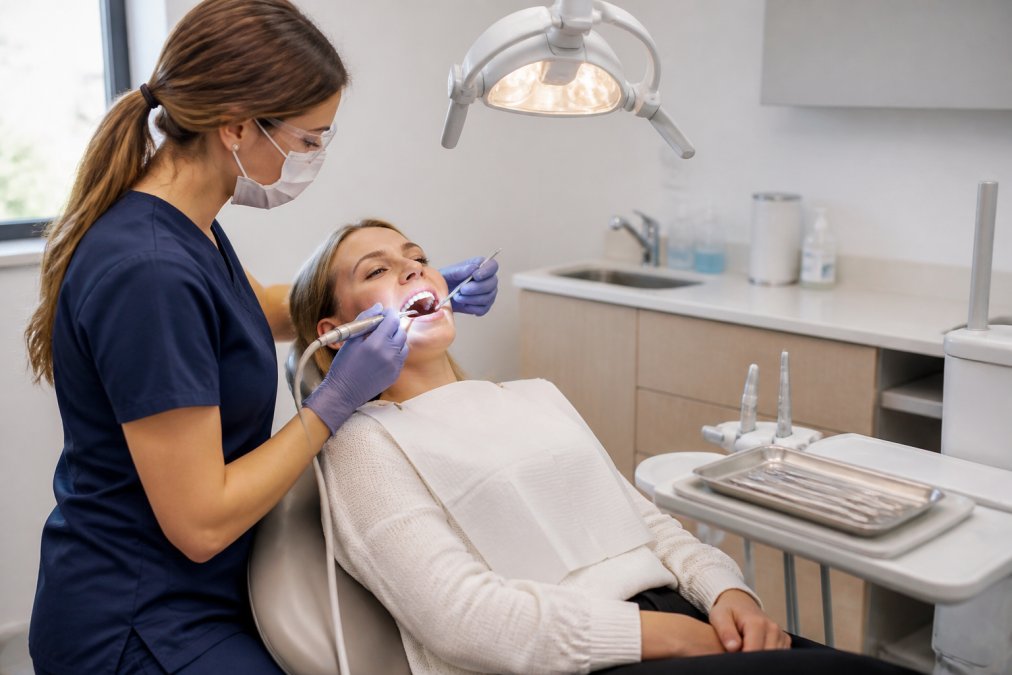
A standard prophylaxis appointment typically includes:
- Removal of calculus deposits using hand scalers and ultrasonic instruments
- Plaque removal from all tooth surfaces
- Polishing to remove surface stains
- Flossing between all contacts
- Oral hygiene instruction tailored to your dental health
Many practices bundle the prophylaxis with a dental exam and bitewing x-rays on an annual visit. These are billed as separate line items, so when you’re comparing out-of-pocket expenses, ask whether the quoted price covers only the cleaning or the full diagnostic services package.
Routine Prophylaxis vs. Deep Cleaning (Scaling and Root Planing)
The difference between a routine prophylaxis and scaling and root planing is clinical, not cosmetic. A routine prophylaxis addresses plaque and calculus above the gumline in patients with healthy gum tissue. Scaling and root planing is a therapeutic procedure for patients with active periodontal disease, involving instrumentation below the gumline to clean root surfaces and reduce bacterial load in periodontal pockets.
Scaling and root planing is typically performed in quadrants across multiple appointments. It costs meaningfully more than a prophylaxis and is sometimes followed by a course of local antibiotic therapy. If your hygienist recommends it, request a written treatment plan before agreeing, so you understand the full scope of out-of-pocket expenses.
When Full Mouth Debridement or Periodontal Maintenance Is Needed
Full mouth debridement is performed when heavy calculus buildup prevents a thorough clinical assessment. It’s a preliminary procedure, not a replacement for prophylaxis. After debridement, the dentist can properly evaluate your periodontal status and determine whether routine cleaning or scaling and root planing is appropriate.
Periodontal maintenance is the ongoing care protocol for patients who have completed scaling and root planing. It replaces the standard prophylaxis for those patients and is typically recommended every three to four months rather than the standard six-month interval. Uninsured patients should factor this increased frequency into their annual dental health budget.
Dental Savings Plans: A Practical Alternative to Insurance
Dental savings plans are membership-based discount programs offered directly by dental offices or third-party networks that reduce the cost of dental cleaning without insurance for enrolled patients. They are not insurance: there are no claims, no deductibles, no annual maximums, and no waiting periods.
A typical dental savings plan covers preventive care, including prophylaxis and bitewing x-rays, at either no additional charge or a reduced fee, with discounts applied to restorative and specialty procedures. For patients who need only routine checkup visits and occasional restorative work, a savings plan often delivers better value than purchasing individual dental benefits on the open market.
According to National Association of Dental Plans consumer guidance, dental savings plans have grown significantly as an alternative for the uninsured population. The key questions to ask before enrolling: what procedures are covered, what the discount percentage is on restorative work, and whether your preferred provider participates.
Ask your dental office directly whether they offer an in-house membership plan. Many practices, particularly locally owned ones, offer annual plans that bundle two prophylaxis visits, a dental exam, and x-rays for a flat annual fee, with discounts on anything beyond that. These plans are not advertised widely but can cut your annual oral health maintenance costs substantially.
Sendero Dental Studio offers an uninsured patient special for patients without dental benefits, designed to make preventive care accessible without the complexity of insurance claims. Contact the office directly to learn what’s currently included.
How to Find Affordable Dental Care When You’re Uninsured
Affordable dental care for uninsured patients exists at multiple access points. The mistake most people make is assuming the only option is a full-fee private practice. That assumption leaves real money on the table.

Dental Schools and Community Health Centers
Dental school clinics provide prophylaxis, scaling and root planing, and many restorative procedures at significantly reduced rates. Procedures are performed by supervised dental students or residents, which means appointments take longer, but the clinical quality is subject to faculty oversight. For patients with straightforward preventive care needs, dental schools are one of the most reliable low-cost options available.
Federally Qualified Health Centers (FQHCs) are another strong option. These community health centers receive federal funding to provide care on a sliding scale fee basis, meaning your out-of-pocket expenses are calculated based on your household income. According to Health Resources and Services Administration FQHC locator, there are thousands of FQHC sites across the country. Use the HRSA locator to find one near you.
Charitable dental clinics, often run by nonprofit organizations or dental associations, hold periodic free or reduced-cost care events. The American Dental Association’s Give Kids A Smile program and Mission of Mercy events are examples worth searching in your area.
Negotiating Cash Rates and Payment Arrangements
Most patients don’t realize that dental offices routinely offer cash discounts to uninsured patients. When an office bills an insurance carrier, they accept a contracted rate lower than their posted fee. An uninsured patient paying cash is, from a practice management standpoint, equivalent to an insured patient, so many offices will extend a similar discount.
The negotiation is straightforward. Call the office, explain that you’re uninsured, and ask whether they offer a cash discount or fee-for-service rate for self-pay patients. Ask for the fee before your appointment, not after. For larger treatment plans, ask whether payment arrangements are available, either through the practice directly or through a third-party patient financing program.
A common approach is to request a written treatment plan with itemized procedure codes before committing. This lets you compare costs across providers using the CDT procedure code system, which is standardized, so the same code means the same procedure regardless of which office you call.
Tax Deductibility of Dental Expenses
Dental expenses, including the cost of dental cleaning without insurance, may be deductible as medical expenses on your federal income tax return. The IRS allows taxpayers who itemize deductions to deduct qualifying medical and dental expenses that exceed a threshold percentage of their adjusted gross income. The specific threshold and eligibility rules change periodically, so check the IRS Publication 502 on medical and dental expenses for current guidance rather than relying on a fixed number stated here.
Dental prophylaxis, scaling and root planing, periodontal maintenance, and diagnostic services all qualify as deductible medical expenses under IRS rules. Keep itemized receipts from every dental visit.
Why Skipping a Dental Cleaning Costs More in the Long Run
Skipping preventive care to save money is the most expensive dental decision most people make. This is not a scare tactic. It’s a straightforward clinical and financial reality.
Gingivitis, the earliest stage of gum disease, is reversible with professional cleaning and improved oral hygiene. Left untreated, it progresses to periodontal disease, which requires scaling and root planing rather than a simple prophylaxis, and in advanced cases, surgical intervention. The out-of-pocket difference between treating gingivitis and treating periodontitis is significant.
The same logic applies to cavities. A small cavity caught at a routine checkup requires a filling. A cavity that’s been developing undetected for two years may require a crown, a root canal, or extraction. Each of those procedures carries a dramatically higher cost than the annual visit that would have caught the problem early.
Preventive dentistry is, at its core, a financial strategy. Two prophylaxis visits per year cost a fraction of what a single crown or implant costs. For patients without dental benefits, that math is even more compelling because every dollar of restorative work comes directly out of pocket.
The cost of skipping a dental cleaning is not zero. It’s the difference between a prophylaxis fee and whatever restorative treatment your untreated oral health problem eventually requires. For most people, that gap is measured in hundreds to thousands of dollars.
How Often Should You Get a Dental Cleaning Without Insurance
For most adults with healthy gums, a dental prophylaxis every six months is the standard recommendation for oral health maintenance. This twice-yearly interval is supported by preventive dentistry guidelines and reflects the typical rate at which calculus deposits reform after a professional cleaning.
Patients with a history of periodontal disease, active gingivitis, or other risk factors may need more frequent visits. Periodontal maintenance patients are typically seen every three to four months. Your dental provider will recommend an interval based on your clinical assessment, not a one-size-fits-all schedule.
For uninsured patients trying to manage out-of-pocket expenses, the instinct to stretch cleanings to once per year or less is understandable. The problem is that a longer interval between visits increases the likelihood that calculus buildup will be heavy enough to require full mouth debridement rather than a standard prophylaxis, which costs more, not less. Staying on a consistent schedule is both clinically and financially sound.
If budget constraints make twice-yearly visits difficult, discuss it openly with your dental provider. Many practices will work with patients on payment arrangements or can help identify the most cost-effective visit schedule for your specific oral health status.
Going without dental insurance shouldn’t mean going without dental care. The cost of dental cleaning without insurance is manageable when you understand what drives pricing, what options exist for reducing out-of-pocket expenses, and why consistent preventive care is the most cost-effective approach long term. Sendero Dental Studio provides comprehensive preventive and restorative care for uninsured patients, with a patient special designed to make routine hygiene accessible and transparent. Request your appointment with Sendero Dental Studio and take the first step toward protecting your oral health on your terms.
Frequently Asked Questions
Do dentists charge more if you don’t have insurance?
Many dental offices publish a standard fee schedule that applies to all patients, insured or not. However, patients with insurance often receive pre-negotiated rates their carrier has arranged. Without insurance, you pay the office’s full listed fee. The good news: many practices offer cash discounts, in-house dental savings plans, or payment arrangements specifically for uninsured patients. Always ask the front desk about fee-for-service discounts before your appointment.
Can I negotiate the cost of a dental cleaning?
Yes, negotiation is more common than most patients realize. Dental offices frequently offer reduced rates for patients who pay in cash at the time of service, since it eliminates billing overhead. You can also ask whether the practice has an in-house dental savings plan, a sliding scale fee structure, or a new-patient special. Being upfront about your uninsured status before treatment gives the office room to work with you on cost transparency and payment arrangements.
What is included in a standard dental cleaning appointment?
A standard prophylaxis typically includes removal of plaque buildup and calculus (tartar) from tooth surfaces, polishing to remove surface stains, and a flossing treatment. Most annual visits also include a clinical assessment by the dentist, a review of your oral hygiene habits, and diagnostic services such as bitewing X-rays when clinically indicated. The full scope depends on your dental health history and how long it has been since your last routine checkup.
How often should I get a dental cleaning if I’m paying out-of-pocket?
Most dental providers recommend a professional cleaning every six months as part of standard preventive care. Patients with a history of periodontal disease, gingivitis, or significant plaque buildup may need periodontal maintenance visits every three to four months. If out-of-pocket expenses are a concern, discuss your oral health history with your dentist to determine the minimum frequency that still protects your dental health without unnecessary visits.
Are there low-cost dental clinics for uninsured patients?
Yes. Federally Qualified Health Centers (FQHCs), which receive funding under the Health Resources and Services Administration (HRSA), offer sliding scale fees based on household income. Dental school clinics provide supervised care at significantly reduced rates. Some nonprofit organizations and charitable dental events also offer free or low-cost preventive dentistry services. Searching the HRSA health center finder at findahealthcenter.hrsa.gov is a reliable starting point for locating nearby options.
This article was written using GrandRanker