
Benefits of Regular Dental Exams for Long Term Health
Table of Contents
- Why Regular Dental Exams Matter for Long Term Health
- The Importance of Preventive Dental Care: What the Evidence Shows
- What Happens During a Dental Exam: A Step-by-Step Walkthrough
- How Often to Get a Dental Cleaning: Personalized Visit Frequency
- Early Signs of Gum Disease and Other Problems Your Dentist Can Catch
- Overcoming Dental Anxiety and Finding Accessible Care
- The Cost of Prevention vs. Treatment: Insurance and Out-of-Pocket
- Conclusion: Making Regular Dental Exams a Priority
- Frequently Asked Questions
Last Updated: October 6, 2026
Why Regular Dental Exams Matter for Long Term Health
The benefits of regular dental exams for long term health extend far beyond a cleaner smile. They are one of the most reliable, low-effort ways to protect your teeth, your gums, and, increasingly, your overall wellbeing.
Here is the core idea we want you to take away: dentistry has quietly shifted from a repair business to a prevention business. The patients who fare best over a lifetime are rarely the ones who needed the most dramatic interventions.
That shift matters because the alternative is expensive and uncomfortable. A small cavity caught at a routine checkup is a straightforward filling.
Below, we break down the evidence, walk through an exam step by step, and answer the practical questions people actually ask: how often, what it costs, and what to do if you have been avoiding the dentist.
The Importance of Preventive Dental Care: What the Evidence Shows
Preventive dental care is the practice of protecting your teeth and gums through routine examinations, professional cleanings, and daily home care, rather than waiting to treat problems after they cause pain. The goal is to interrupt disease early, when intervention is simple.
Most dental disease is slow and largely silent at the start. Tooth decay and gum disease both begin with bacteria that accumulate along the gumline and between teeth. In the early stages, neither condition typically causes noticeable pain.
What does the evidence actually support? Broadly, three things:
- Early detection works. Screening at regular intervals catches cavities, early-stage periodontal disease, and oral cancer at points where treatment is simpler and less invasive.
- Professional removal matters. Brushing and flossing disrupt plaque, but hardened tartar can only be removed with professional instruments. Left in place, tartar keeps irritating the gums and fuels gum disease.
- Prevention reduces complex treatment. Patients who maintain consistent preventive care tend to avoid the restorative cascade of root canals, extractions, and implants that follows years of untreated disease.
A common mistake is treating a checkup as a formality you can skip when nothing hurts. In practice, “nothing hurts” is the best time to be seen, not a reason to stay home.
The Oral-Systemic Health Connection
Mounting research links oral health to long-term health, though the picture is more nuanced than headlines suggest. Gum disease is associated with conditions including cardiovascular disease, diabetes, and adverse pregnancy outcomes.
We want to be careful here, because this is where a lot of marketing overreaches. The evidence supports association and plausible mechanisms, not a claim that treating your gums will prevent heart disease. Still, the practical takeaway is sound.
For patients managing diabetes or heart conditions, this connection makes consistent dental care more important, not less. If you have a chronic health condition, tell your dentist. It changes how we assess your risk and how often we recommend you come in.
What Happens During a Dental Exam: A Step-by-Step Walkthrough
A dental exam is a structured assessment of your teeth, gums, and surrounding tissues, followed by a professional cleaning. Most visits follow a predictable sequence, which helps if you have been anxious about the unknown.
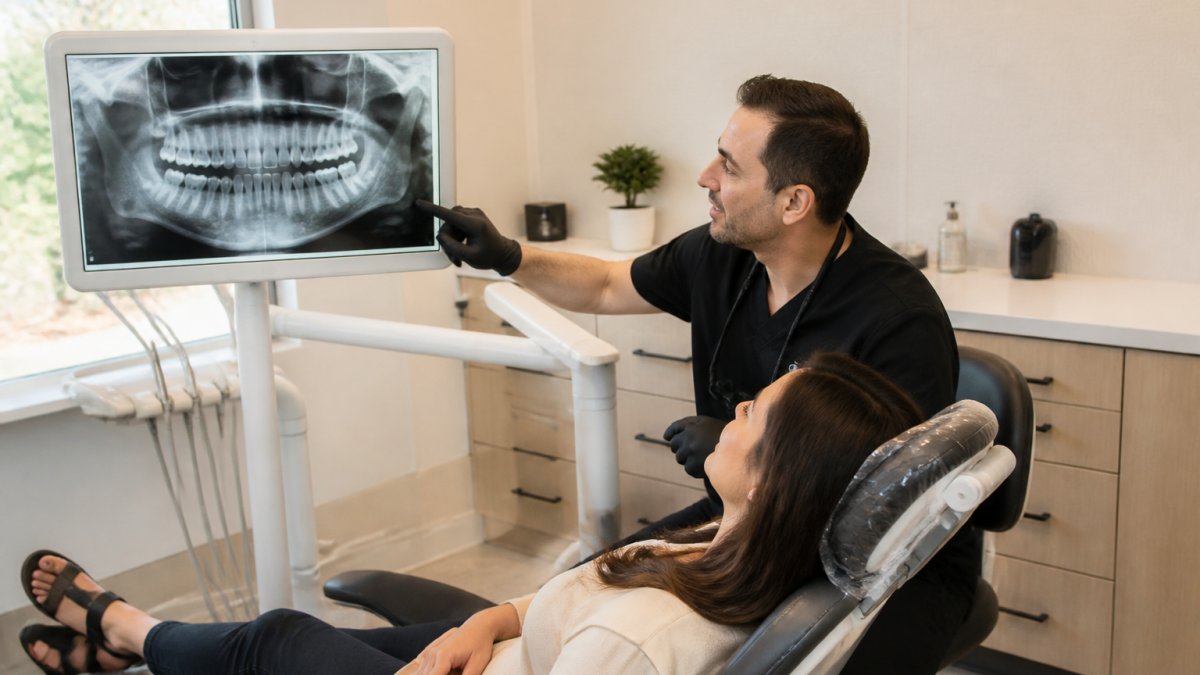
Here is what a typical visit looks like:
- Medical history review. We ask about medications, health conditions, and any changes since your last visit. This shapes everything that follows.
- Visual examination. Your dentist inspects each tooth, checking for decay, cracks, worn fillings, and signs of wear.
- Gum assessment. We measure the pockets between your teeth and gums. Deeper pockets can signal early-stage periodontal disease.
- Dental X-rays. Taken at intervals based on your risk, X-rays reveal decay between teeth, bone loss, and problems below the surface that a visual exam cannot reach.
- Oral cancer screening. Your dentist checks the lips, tongue, throat, and soft tissues for unusual changes.
- Professional cleaning. A hygienist removes plaque and tartar, then polishes your teeth.
- Discussion and plan. We talk through findings, answer questions, and outline any personalized treatment options.
The whole visit usually takes under an hour. If it has been a while since your last appointment, expect a little more time for the cleaning.
How Often to Get a Dental Cleaning: Personalized Visit Frequency
The standard recommendation for most adults is a cleaning and exam every six months. That interval works well for people with healthy teeth and gums and no major risk factors.
But six months is a default, not a rule carved in stone. Your ideal frequency depends on your individual risk profile. Factors that may push you toward more frequent visits include:
- A history of cavities or gum disease
- Smoking or tobacco use
- Diabetes or another condition affecting healing and inflammation
- Medications that cause dry mouth
- Pregnancy
- Poor access to consistent home care
For patients with early-stage periodontal disease, a dentist may recommend visits every three to four months to keep the condition from progressing. For someone with excellent oral hygiene and no history of problems, a slightly longer interval may be reasonable.
The honest answer is that visit frequency should be a decision you make with your dentist, based on your risk assessment, not a number you pick from a calendar. Biannual checkups are the right starting point for most people, and your dentist can adjust from there.
Early Signs of Gum Disease and Other Problems Your Dentist Can Catch
Gum disease rarely announces itself. In its earliest stage, it may cause nothing more than occasional bleeding when you brush. That is why a professional examination catches things you would miss at home.
Watch for these early signs of gum disease:
- Gums that bleed when you brush or floss
- Red, swollen, or tender gums
- Persistent bad breath
- Gums pulling away from the teeth
- Teeth that feel loose or have shifted
Any of these warrants a visit. Early-stage periodontal disease is manageable, and catching it early is the difference between a deep cleaning and a much longer treatment road.
Bleeding gums are not normal, and “just brushing harder” makes it worse. Persistent bleeding usually signals inflammation that needs a professional assessment. Ignoring it for months or years is how early gum disease becomes advanced periodontal disease, which can lead to tooth loss.
Cavities, Oral Cancer, and Systemic Conditions
Beyond gum disease, a routine exam screens for several other problems that are far easier to treat when found early.
Cavities and tooth decay are the most common finding. Early decay is often reversible with fluoride and improved hygiene. Once it breaks through the enamel, it needs a filling. Left longer, it reaches the pulp and requires a root canal.
Oral cancer screening is a brief visual and manual check of the mouth, throat, and neck. Oral cancer is far more treatable when caught early, which is why we examine soft tissues at every routine visit.
Systemic conditions sometimes show their first signs in the mouth. Dry mouth, unusual lesions, and gum changes can reflect diabetes, nutritional deficiencies, or medication side effects. Your dentist may be the first to notice.
Bring a list of your current medications to every visit. Many common prescriptions cause dry mouth, which raises cavity risk. Knowing this lets your dentist adjust your preventive plan rather than waiting to treat the damage.
Overcoming Dental Anxiety and Finding Accessible Care
Dental anxiety is common, and it is nothing to be embarrassed about. For many people, the fear traces back to a single bad experience, often in childhood. The good news is that modern practices are built to accommodate it, and there are concrete steps that help.
If anxiety has kept you away, try these:
- Say so upfront. Tell the front desk and your dentist. When we know, we can explain each step before it happens and agree on a signal to pause.
- Start with a visit, not a procedure. A first appointment can be a conversation and a look, nothing more.
- Ask about accommodations. Many practices offer options to make visits more comfortable. Ask what is available.
- Bring support. A family member or friend in the room can make a real difference.
- Book the earliest appointment of the day. Less time to build up dread.
Access is the other half of the equation. If cost or scheduling is the barrier, ask about payment options and uninsured patient specials before you assume you cannot afford care. Sendero Dental Studio offers an uninsured patient special and our team can walk you through what a visit involves, so you know what to expect before you commit.
The Cost of Prevention vs. Treatment: Insurance and Out-of-Pocket
Preventive care is almost always cheaper than restorative care, and that gap is the strongest financial argument for keeping up with visits. What a cleaning and exam costs depends on your insurance, your location, and what the visit involves, so we cannot quote a single number that applies to everyone.
Here is how the math generally works:
| Category | Typical Nature of Cost | What It Covers |
|---|---|---|
| Preventive visit | Lowest, often covered by insurance | Exam, cleaning, routine X-rays |
| Minor restorative | Moderate | Fillings, small repairs |
| Major restorative | Highest | Crowns, root canals, implants, dentures |
Many dental insurance plans cover preventive visits at little or no out-of-pocket cost, because insurers know prevention reduces their own long-term payouts. If you have insurance, check your plan’s preventive coverage before assuming a visit will be expensive.
If you do not have insurance, ask about payment plans and specials. Cost should not be the reason you skip a visit that could save you far more later. Sendero Dental Studio offers an uninsured patient special, and our team can explain your options before any treatment begins.
The cheapest dental visit is the preventive one. Every dollar spent on routine care is aimed at avoiding the much larger cost of a root canal, a crown, or an implant down the road.
Conclusion: Making Regular Dental Exams a Priority
The case for consistent care is straightforward: prevention is simpler, cheaper, and more comfortable than treatment. The benefits of regular dental exams for long term health show up in your mouth and, increasingly, in your overall wellbeing. The challenge is turning that knowledge into a habit that survives busy schedules and old anxieties.
At Sendero Dental Studio, we make that habit easier. Our team provides comprehensive, family-oriented care for patients of every age, from routine hygiene to same-day emergency visits. We use advanced technology to keep treatment comfortable, and we take the time to explain what we find and why it matters, so you are never pushed into care you do not understand.
Get started with Sendero Dental Studio and build a preventive routine that protects your smile for decades.
Frequently Asked Questions
What are the health benefits of regular dental checkups?
Regular dental checkups help prevent cavities, gum disease, and tooth loss by removing plaque and tartar and catching problems early. They also support long-term health: research links gum disease to conditions like heart disease and diabetes. Plus, checkups can screen for oral cancer and other issues that are easier to treat when found early. For many people, a checkup every six months is recommended, but your dentist may suggest a different schedule based on your risk factors.
Do you really need a dental cleaning every 6 months?
For many adults and children, a cleaning every six months is a good baseline. However, the ideal frequency depends on your individual risk factors. People with a history of gum disease, cavities, or certain health conditions may need more frequent visits, such as every three to four months. Others with excellent oral hygiene and low risk might be fine with longer intervals. Your dentist can personalize the schedule based on your needs.
What can a dentist detect during a routine dental exam?
A routine dental exam can detect cavities, early gum disease, oral cancer, and signs of systemic conditions like diabetes or acid reflux. Dentists also check for worn enamel, cracked teeth, and issues with existing fillings or crowns. X-rays can reveal problems below the surface, such as impacted teeth or bone loss. Early detection often means simpler, less expensive treatment.
What happens if you skip routine dental checkups?
Skipping routine checkups allows plaque and tartar to build up, increasing the risk of cavities and gum disease. Without professional cleaning, early signs of problems may go unnoticed until they become painful or require complex treatment. Gum disease can progress to periodontitis, leading to tooth loss and potential impacts on overall health. Regular visits help you avoid emergencies and keep treatment costs down.