
How Long Does a Dental Crown Procedure Take?

Table of Contents
- What Is a Dental Crown and Who Needs One?
- Dental Crown Procedure Steps: A Visit-by-Visit Breakdown
- How Long Does Each Stage Actually Take?
- Same-Day Dental Crown Process: How It Compresses the Timeline
- Dental Crown Recovery Time and Pain Management
- Complications That Can Extend the Timeline
- Insurance, Financing, and Scheduling Timelines
- Frequently Asked Questions
Last Updated: September 26, 2026
What Is a Dental Crown and Who Needs One?
A dental crown is a custom-fitted cap that covers a damaged or weakened tooth to restore its shape, size, strength, and appearance. Most patients finish a traditional crown in two visits, though the exact timeline depends on the tooth and the type of crown.
You may need a crown if you have:
- A tooth with a large cavity that a filling can’t support
- A cracked or fractured tooth
- A tooth worn down by grinding
- A missing tooth supported by a dental bridge
- A tooth that had a root canal and needs protection
Dental Crown Procedure Steps: A Visit-by-Visit Breakdown
The dental crown procedure steps follow a predictable path: prepare the tooth, take an impression, place a temporary crown, then fit and cement the permanent crown. A traditional crown takes two clinical visits, usually spaced one to two weeks apart.
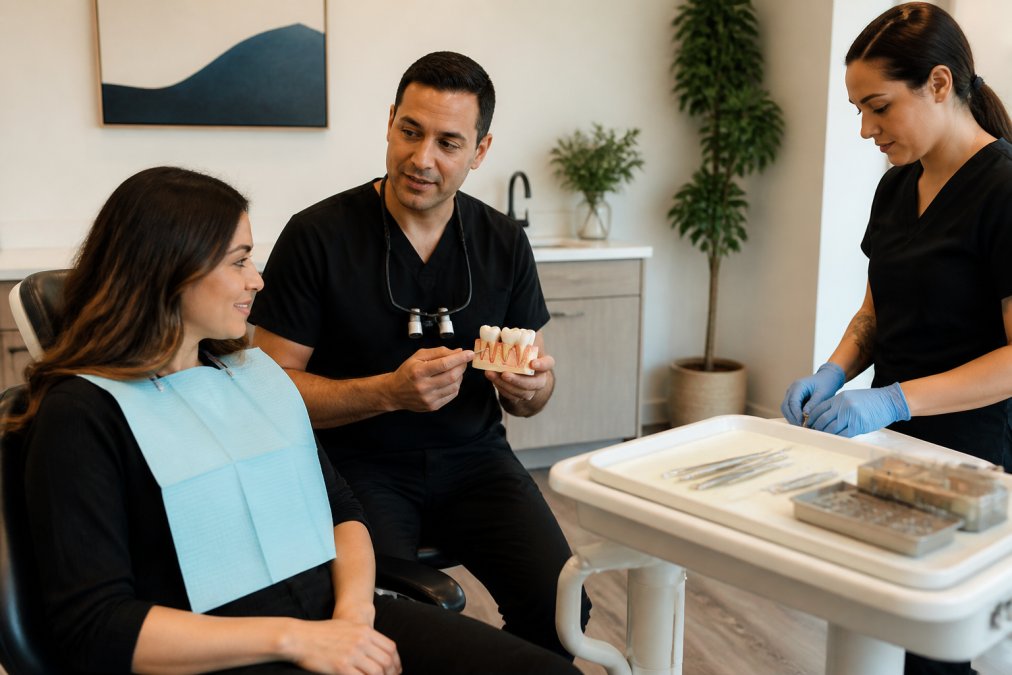
First Visit: Preparation and Temporary Crown Placement
The first visit runs 60 to 90 minutes. Your dentist numbs the area with local anesthesia, then reshapes the tooth so the crown fits over it.
Second Visit: Fitting and Cementation of the Permanent Crown
The second visit takes 30 to 45 minutes. Your dentist removes the temporary crown, checks the fit and color of the permanent one, and adjusts the bite.
How Long Does Each Stage Actually Take?
Each stage of a dental crown procedure takes a set amount of chairside time, and knowing the breakdown helps you plan your day. Here’s how the time adds up.
| Stage | Typical Time | What Happens |
|---|---|---|
| Exam and X-rays | 15-20 min | Confirm the tooth needs a crown |
| Tooth preparation | 20-30 min | Reshape the tooth under anesthesia |
| Digital impressions | 10-15 min | Scan the tooth for the lab |
| Temporary crown | 10-15 min | Protect the tooth between visits |
| Permanent fitting | 30-45 min | Check fit, cement, adjust bite |
Same-Day Dental Crown Process: How It Compresses the Timeline
The same-day dental crown process finishes everything in a single appointment, often in two to three hours. CAD/CAM technology and an in-office milling machine let the dentist design and craft the crown while you wait.
How it works:
- The dentist prepares the tooth and takes a digital scan
- Software designs the crown on screen
- The milling machine carves it from a ceramic block
- The crown is fitted, adjusted, and cemented
Dental Crown Recovery Time and Pain Management
The clock that matters most to patients is not chairside time, it is the downtime after the anesthesia wears off. Those are two different timelines, and separating them is the clearest way to plan your day and your week.
Procedure Time vs. Recovery Time
Procedure time is the minutes you spend in the chair. Recovery time is how long your mouth feels different afterward. For a traditional crown, the first visit is the longer appointment, but the second visit is usually the easier recovery because no tooth structure is removed.
| Phase | Typical Duration | What You Feel |
|---|---|---|
| Local anesthesia | 2-4 hours to fully wear off | Numb lip, cheek, or tongue |
| Immediate post-op (first 24 hours) | 1 day | Gum tenderness, mild pressure |
| Sensitivity window | 3-7 days | Hot and cold sensitivity near the gum line |
| Bite settling | 1-2 weeks | Crown feels slightly high or foreign |
| Full adjustment | 2-4 weeks | Crown feels like your own tooth |
What to Expect in the First 48 Hours
- Gum tissue around the prepared tooth may feel tender where the retraction cord or bur touched it
- Sensitivity to cold is more common than sensitivity to heat in the first few days
- The temporary crown may feel slightly bulky; this is normal and usually resolves when the permanent crown is seated
- A faint taste of cement or a slight chemical smell can linger for a day after cementation
Stick to soft foods, yogurt, eggs, mashed vegetables, smoothies, for the first day. Avoid sticky foods like caramel or taffy, which can pull a temporary crown loose. Brush gently around the crown and floss carefully; a water flosser on a low setting is often easier on the gum line than string floss during the first week.
Managing Pain Without Overdoing It
If your dentist prescribed a stronger pain reliever, take it exactly as directed and do not combine it with over-the-counter options without asking. Too much acetaminophen is a real risk when it is hidden inside combination products (the FDA).
Cold sensitivity usually fades as the nerve settles. If it does not improve after two weeks, or if it gets worse, that is a signal to call, it can mean the crown is sitting high, the margin is open, or the tooth needs further treatment.
When to Call Your Dentist
Call your dentist if you notice:
- Pain that gets worse instead of better after day three
- A crown that feels loose, rocks, or falls off
- Sharp edges that cut your tongue or cheek
- A bite that feels uneven or high, especially if you wake up with jaw soreness
- Swelling, a bad taste, or fever, which can point to an infection
These issues are usually easy to fix with a quick adjustment. A high bite, in particular, is one of the most common reasons a crown feels wrong, and one of the easiest to correct with a few minutes of polishing.
The Recovery Timeline Most Articles Skip
Most guides stop at “a few days.” In practice, the timeline has three distinct phases: the anesthesia phase (hours), the tissue-healing phase (days), and the bite-settling phase (weeks). Knowing which phase you are in helps you decide whether a sensation is normal or worth a phone call. If you are still avoiding that side of your mouth after a month, that is not a recovery issue, that is a fit issue, and it is worth a follow-up visit.
Complications That Can Extend the Timeline
Some cases take longer than the standard two visits. A tooth with deep decay, a cracked root, or an infection may need a root canal first. That adds appointments before the crown work even starts.
Other timeline extenders include:
- A crown that doesn’t fit and needs to be remade by the dental lab
- Gum tissue that needs to heal before impressions
- A bite that needs multiple adjustments
- Emergency cases that push non-urgent appointments back
Insurance, Financing, and Scheduling Timelines
Clinical time is only half the story. The other half is the administrative clock, and it is the part most articles skip entirely. For many patients, the longest wait in the crown process is not the lab; it is the paperwork.
How Pre-Authorization Actually Works
Most dental plans treat a crown as a major restorative service, which means the plan often wants to review the claim before treatment starts. That review is called pre-authorization or pre-determination. It is not the same as a guarantee of payment, but it tells you what the plan expects to cover.
A typical pre-authorization sequence looks like this:
- Your dentist submits the treatment plan, X-rays, and often a narrative explaining why the crown is medically necessary
- The plan reviews the file, commonly a few business days, sometimes longer if the file is incomplete
- The plan returns an estimate of benefits, which the office uses to calculate your out-of-pocket portion
- You approve the estimate, and the office schedules the preparation visit
What Speeds Up or Slows Down Approval
- Clean documentation: Clear X-rays and a specific narrative tend to move faster than vague submissions
- Plan type: Some plans route crowns through a third-party review, which adds a layer
- Waiting periods: Many plans require the tooth to have been covered for a set period before major services apply
- Frequency limits: Most plans cover one crown per tooth every several years, and a recent prior crown can trigger a denial
- Coordination of benefits: If you are covered by two plans, the primary and secondary payers have to coordinate, which adds time
If your plan denies the claim, that is not always the end. Many denials are documentation issues rather than coverage issues, and a resubmission with a stronger narrative or additional imaging often changes the outcome.
Financing Options and How They Affect Scheduling
For patients without insurance, or with a plan that leaves a large balance, the financing decision often determines the schedule. Common options include:
- In-office payment plans, which spread the balance over a few months
- Third-party dental financing, which can offer longer terms and sometimes promotional interest periods
- Health savings or flexible spending accounts, which let you pay with pre-tax dollars if the crown qualifies as a medical expense
- Membership or in-house savings plans, which some practices offer instead of traditional insurance
Skipping a needed crown because of cost or timing usually backfires. A cracked tooth can split completely, and that often means an extraction and a more expensive replacement instead of a simple fix.
Building a Realistic Schedule
A realistic timeline for a traditional crown, once you account for the administrative side, often looks like this:
| Step | Typical Wait |
|---|---|
| Consultation and treatment plan | Same day to 1 week |
| Insurance pre-authorization (if required) | 3-10 business days |
| Preparation visit | Scheduled after approval |
| Lab fabrication | 1-2 weeks |
| Permanent crown seating | 30-45 minute visit |
Questions Worth Asking Before You Book
- Does my plan require pre-authorization for this crown, and has it been submitted?
- What is my estimated out-of-pocket cost after the plan’s contribution?
- Is there a waiting period or frequency limit that applies to this tooth?
- What financing options are available if the estimate is higher than expected?
- How soon can the preparation visit be scheduled once approval comes through?
Getting clear answers to those five questions before treatment starts is the difference between a predictable timeline and a month of uncertainty.
Frequently Asked Questions
Can I drive myself home after getting a dental crown?
In most cases, yes. The local anesthesia used during a dental crown procedure numbs only your mouth, not your entire body, so your alertness and reflexes stay normal. If your dentist also uses sedation to help with anxiety, you will need a friend or family member to drive you home and stay with you for a few hours. Ask your dental team which type of anesthesia they plan to use so you can arrange transportation ahead of time.
How painful is the dental crown procedure?
The procedure itself is not painful because local anesthesia blocks sensation in the treated tooth and surrounding gum. You may feel pressure, vibration, or a cold sensation during tooth preparation, but sharp pain is not typical. After the anesthesia wears off, mild soreness at the gum line or jaw is common for a day or two. Over-the-counter pain relievers usually manage it. Contact your dentist if pain worsens instead of improving, since that can signal a bite alignment issue.
How long does a temporary crown stay on?
A temporary crown typically stays in place for about two to three weeks while the dental lab fabricates your permanent crown. In some cases, the wait can stretch longer if the lab needs more time or your schedule delays the second visit. Temporary crowns are made of acrylic or composite and are not designed for long-term use. Avoid sticky foods and hard chewing on that side to keep it from loosening before your permanent crown is cemented.
Can a tooth decay underneath a dental crown?
Yes, a tooth can still decay under a crown, especially at the margin where the crown meets the gum line. That area is not fully sealed against bacteria, and poor dental hygiene lets plaque accumulate there. Keeping up with brushing, flossing around the crown, and regular dental checkups protects the tooth underneath. If decay develops, the crown may need to be removed and replaced, which extends your overall treatment timeline.