
Standard vs Deep Cleaning Costs: What to Expect

Table of Contents
- Standard vs Deep Cleaning: What’s the Real Difference?
- Factors Affecting Professional Cleaning Quotes
- Standard Cleaning vs Deep Cleaning Frequency
- Deep Cleaning Checklist for Residential Homes
- Cost Comparison: Standard vs Deep Cleaning
- When to Choose a Deep Clean Over Standard Service
- Conclusion
- Frequently Asked Questions
Last Updated: October 3, 2026
Standard vs Deep Cleaning: What’s the Real Difference?
The gap between standard and deep cleaning comes down to time, detail, and what gets touched. A standard visit covers routine surface-level hygiene. A deep clean reaches buildup that regular visits leave behind.
At Sendero Dental Studio, we explain this distinction to families every week. Most people assume the two services are interchangeable. They are not, and treating them as the same thing is how patients end up surprised by a bill or by a diagnosis they did not expect.
The American Dental Association’s guidance on professional cleanings separates preventive visits from therapeutic treatment for good reason. One maintains health. The other restores it.
This guide breaks down what each service includes, what drives the price, and how to decide which one you actually need.
Defining Standard Cleaning
A standard cleaning is a routine preventive appointment for people whose gums and teeth are generally healthy. It includes plaque removal above the gumline, polishing, flossing, and a visual exam.
The goal is maintenance. Nothing more.
Defining Deep Cleaning
A deep cleaning is a therapeutic procedure for active gum disease. It involves scaling and root planing, which reaches below the gumline to remove tartar buildup and smooth the tooth roots.
This is not a fancier version of a regular visit. It is a different treatment with a different clinical purpose, and it typically requires numbing.
Factors Affecting Professional Cleaning Quotes
Several variables move a professional cleaning quote up or down, and understanding them helps you read an estimate without guessing.
- Service scope: A standard maintenance visit and a deep perio treatment are priced on completely different scales because the chair time and clinical skill differ.
- Time and labor intensity: Deep cleaning often requires two appointments, one per side of the mouth, which doubles the labor involved.
- Provider type: A general dental office, a periodontist, and a dental hygiene school all price differently.
- Insurance status: Out-of-pocket costs swing widely depending on whether a plan covers preventive care at 100% and periodontal treatment at a lower tier.
- Geography: Overhead, rent, and local wages push prices higher in some markets than others.
Many practices quote a flat fee for standard visits and an hourly rate or per-quadrant fee for deep cleaning. Ask which model applies before you book. The CDC’s overview of oral health and gum disease is a useful starting point for understanding why treatment urgency changes the quote.
Ask for a written treatment plan with procedure codes before any deep cleaning begins. Those codes let you call your insurer and get a real out-of-pocket number instead of an estimate.
Standard Cleaning vs Deep Cleaning Frequency
Frequency depends on which industry you mean, and the two follow very different rhythms.
Dental frequency. Recall intervals are driven by gum health, not by a calendar rule. Most healthy adults do well with a standard maintenance cleaning every six months. Patients with a history of periodontal disease often need maintenance cleaning every three to four months after a deep cleaning. That shorter interval is not upselling, it is preventative maintenance. Gum disease recurs quietly, and a quarterly visit catches it while it is still reversible. For children and teens, the six-month rhythm usually holds unless an orthodontic appliance changes the cleaning needs.
Residential frequency. Home cleaning runs on a different logic: it is driven by household size, pets, and how much time you are willing to spend between visits. A common pattern looks like this:
- Weekly: households with pets, young children, or allergies. Keeps buildup from ever forming, so a deep clean is rarely needed.
- Bi-weekly: the most common recurring schedule. Balances cost against upkeep and is usually the best per-visit rate.
- Monthly: lighter households or budget-conscious clients. Surface dust and grime start to accumulate between visits.
- Seasonal or one-time deep clean: spring cleaning, move-in/move-out, post-renovation, or after a long gap. This is when a deep clean is the right call rather than a standard visit.
The cost-benefit math is the part most guides skip. In both industries, the cheaper long-run strategy is the same: pay for regular maintenance now rather than for restoration later. In dental, that means a standard cleaning every six months instead of waiting until scaling and root planing is required. In residential, it means a recurring schedule instead of letting buildup reach the point where only a deep clean will fix it. Structural preservation is cheaper than surface restoration, that is not a sales line, it is how both maintenance models work.
If you are weighing bi-weekly home habits against professional visits, remember that brushing and flossing at home are surface-level hygiene. They do not replace professional plaque removal. The same logic applies at home: wiping counters daily does not replace the periodic deep clean that reaches baseboards, appliances, and grout.
The real cost question is not “standard or deep?” It is “how often, and what happens if I wait?” Buildup, whether tartar or grime, does not pause while you decide.
Deep Cleaning Checklist for Residential Homes
Wait. Before we go further, a clarification worth making.
The phrase “deep cleaning” pulls in two completely different searches: dental deep cleaning and residential cleaning. If you searched for home cleaning, here is the short answer, then we return to the dental side.
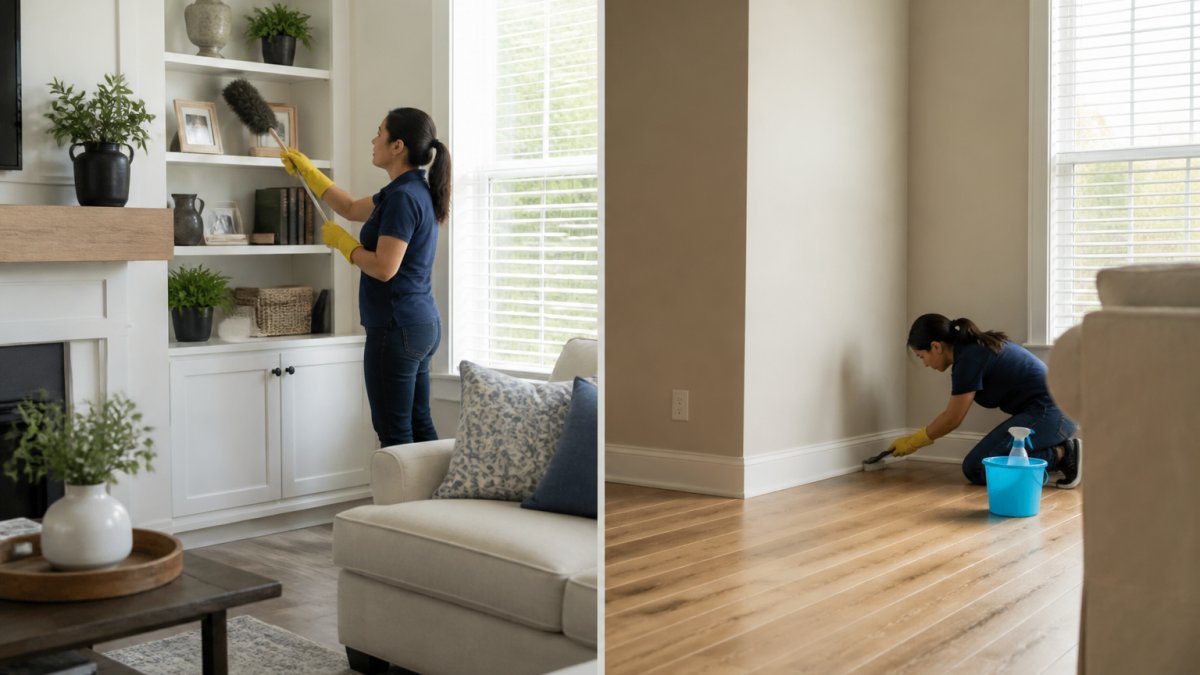
A residential deep cleaning checklist typically covers:
- Baseboards, door frames, and light switches wiped down
- Inside appliances: oven, refrigerator, microwave
- Grout and tile scrubbed
- Vents, ceiling fans, and blinds dusted
- Inside cabinets and closets
- Behind and under movable furniture
Home cleaning services price this by square footage, bedroom and bathroom count, and labor intensity. Dental deep cleaning is priced by quadrant and clinical need. Same phrase, two different industries, two different pricing models.
Booking a “deep cleaning” without confirming which type you mean wastes everyone’s time. If you called a dental office expecting a house cleaner, or vice versa, you will not get the service you wanted.
Cost Comparison: Standard vs Deep Cleaning
Here is the honest answer about pricing: the two services are billed on completely different models, and understanding those models matters more than memorizing a single number.
Standard cleaning (dental). Most general practices bill a routine prophylaxis as a flat fee per visit. When a plan classifies the visit as preventive, it is frequently covered at 100% with no copay.
Deep cleaning (dental). Scaling and root planing is billed per quadrant, four quadrants total, and often split across two appointments. Periodontal coverage is usually a lower tier than preventive care, so a plan that pays 100% for a standard cleaning may pay 50% to 80% for scaling and root planing, and may require a waiting period or a documented diagnosis first.
Standard cleaning (residential). Home cleaning services typically quote a flat rate per visit based on square footage, bedroom and bathroom count, and whether pets are present. With recurring weekly or bi-weekly clients often paying a lower per-visit rate than one-time bookings.
Deep cleaning (residential). A first-time or seasonal deep clean is usually priced at a multiple of the standard rate because of the added labor hours. Add-ons like inside-oven, inside-fridge, and interior windows are frequently quoted separately.
| Factor | Standard Cleaning | Deep Cleaning |
|---|---|---|
| Dental billing model | Flat fee per visit | Per quadrant, often two visits |
| Dental typical range | ~$75-$200 | ~$200-$400 per quadrant |
| Dental insurance tier | Usually preventive (often 100%) | Usually periodontal (often 50-80%) |
| Residential billing model | Flat rate per visit | Multiple of standard rate |
| Residential typical range | ~$100-$200 | ~2-3x the standard rate |
| Biggest price driver | Chair or crew time | Scope, buildup, and labor hours |
The single biggest driver of the price gap in both industries is the same: time and complexity. A standard visit is a maintenance appointment. A deep cleaning is a procedure or a project.
For an accurate number, request a written quote. In dental, ask for the treatment plan with procedure codes (for example, D1110 for a routine adult prophylaxis and D4341 for scaling and root planing per quadrant) so you can call your insurer and get a real out-of-pocket figure. In residential, ask whether the quote is flat-rate or hourly, and whether add-ons are included. The National Institute of Dental and Craniofacial Research on periodontal disease explains why treating gum disease early costs less than waiting.
Procedure codes are the fastest way to turn a vague estimate into a real number. Read them off the treatment plan, then ask your insurer for the allowed amount and your coinsurance before you schedule.
When to Choose a Deep Clean Over Standard Service
Choose a deep clean when there is measurable gum disease, not when you simply want a more thorough visit. Warning signs include gums that bleed when brushing, persistent bad breath, receding gums, and pockets deeper than normal on a periodontal exam.
A standard cleaning on a patient with active gum disease does not help. It can mask the problem while the disease continues.
This is where the cost-benefit math gets interesting, and it is the part most guides skip.
Paying for a deep cleaning now, followed by quarterly maintenance, usually costs less over several years than ignoring the problem until teeth need extraction or implants. Structural preservation is cheaper than surface restoration. That is not a sales line. It is how periodontal health works.
Conclusion
The difference between standard and deep cleaning comes down to what the appointment is designed to do: maintain health or treat disease. One is routine. The other is a procedure. Knowing which you need, and asking for a written plan with procedure codes, keeps you in control of the bill.
At Sendero Dental Studio, we handle routine hygiene, deep cleaning, orthodontics, and restorative care for the whole family, so you are not driving between three offices. Our team offers same-day emergency care and an uninsured patient special for patients without coverage.
Request your appointment with Sendero Dental Studio and get a clear answer about what your smile actually needs.
Frequently Asked Questions
What is considered regular cleaning vs deep cleaning?
Regular cleaning covers upkeep tasks like dusting, vacuuming, mopping, and wiping surfaces to maintain a tidy home. Deep cleaning goes further by addressing buildup in overlooked areas such as baseboards, inside appliances, grout, and behind furniture. The main difference is scope: regular cleaning maintains, while deep cleaning restores. Most homes need regular service weekly or bi-weekly, with a deep clean once or twice a year.
How much more does a deep clean cost compared to a standard cleaning?
Deep cleaning typically costs more than a standard clean because it takes longer and involves more labor-intensive tasks. Exact pricing depends on square footage, bedroom and bathroom count, and the home’s current condition. For a professional quote tailored to your space, contact a local cleaning provider directly rather than relying on generic online averages.
What factors influence the total cost of a professional cleaning service?
Key factors include home size (square footage), number of bedrooms and bathrooms, current condition, whether it is a recurring service, and add-ons like inside-oven or inside-fridge cleaning. Labor intensity and service scope also play a role. Providers may charge an hourly rate or a flat fee. Getting a professional quote ensures accurate pricing for your specific needs.
How often should you schedule a deep cleaning for your home?
Most households benefit from a deep clean every six months, though homes with pets, allergies, or high traffic may need it quarterly. Between deep cleans, standard maintenance cleaning keeps surfaces hygienic. If you are unsure, ask your cleaning provider to assess your home and recommend a schedule that balances cost and cleanliness.