
Dental Bridge vs Partial Denture: Which Fits?
A missing tooth can change more than a photo. It can make meals less enjoyable, affect the way you speak, and leave nearby teeth without the support they need. When comparing a dental bridge vs partial denture, the right choice comes down to where the gap is, the health of your remaining teeth and gums, your budget, and how you want your replacement to feel day to day.
Both options can restore your smile and help you chew more comfortably. Neither is automatically better for every patient. A thoughtful exam and conversation help identify the solution that protects your oral health while fitting your lifestyle.
Dental Bridge vs Partial Denture: The Main Difference
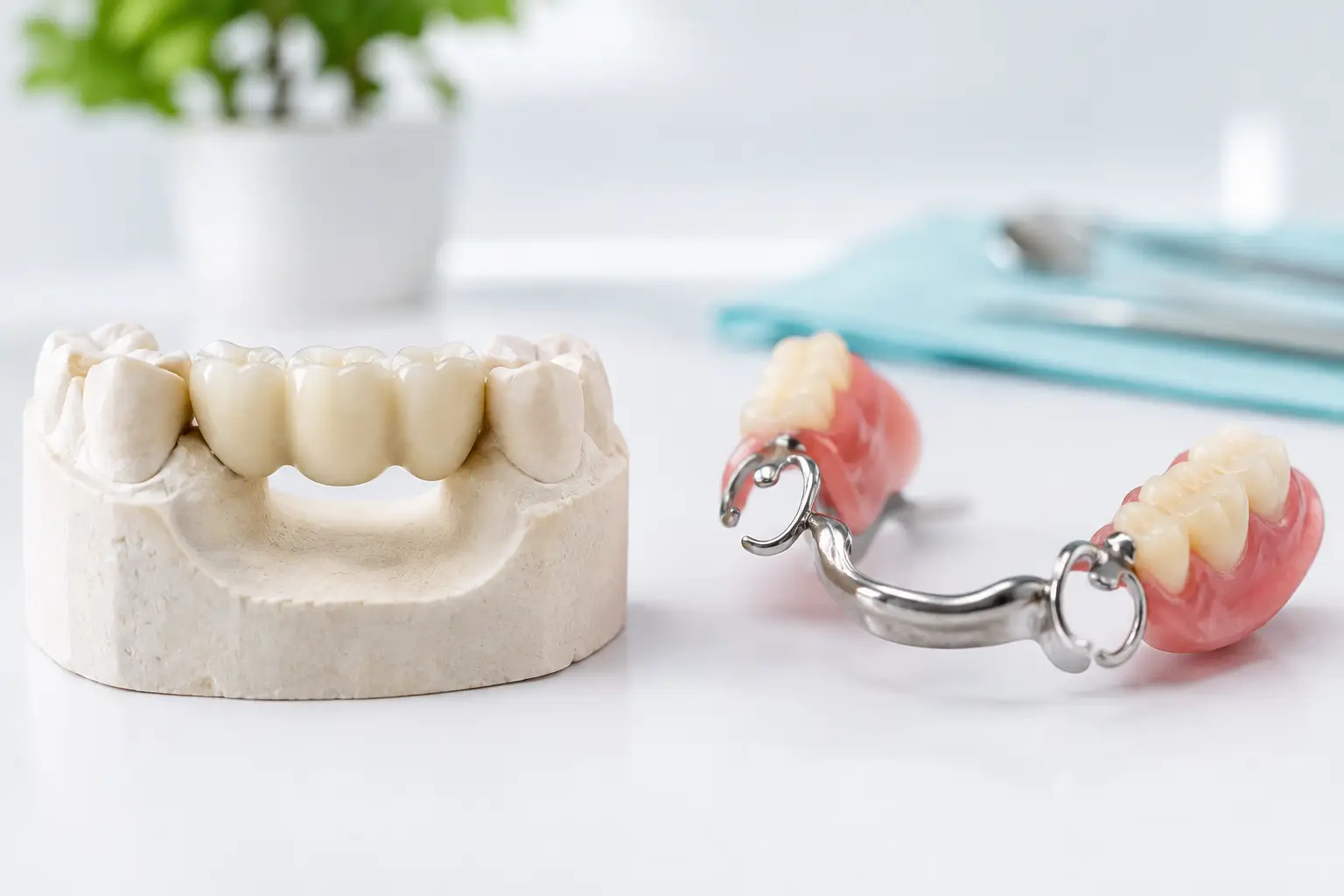
A dental bridge is a fixed restoration that fills a gap created by one or more missing teeth. In a traditional bridge, the teeth on either side of the space are prepared for crowns. A custom artificial tooth, called a pontic, is attached between those crowns and stays in place full time.
A partial denture is a removable appliance used when some natural teeth remain. It includes replacement teeth attached to a gum-colored base, usually supported by a lightweight acrylic or metal framework. Small clasps or precision attachments help it stay in place around existing teeth.
The simplest distinction is this: a bridge is secured in the mouth and is not removed at home, while a partial denture is taken out for cleaning and while you sleep unless your dentist gives you different instructions.
When a Dental Bridge May Be the Better Choice
A bridge can be an appealing option for patients missing one tooth or a short span of teeth, particularly when the neighboring teeth already need crowns because of large fillings, fractures, or wear. It feels stable because it is fixed in place, and many patients find that it quickly becomes part of their normal routine.
Because a bridge does not come out, it can feel more natural when speaking and eating. There are no clasps visible around nearby teeth, which may be especially helpful when replacing a tooth near the front of the smile. The porcelain is custom matched to the color and shape of your natural teeth for a polished, natural-looking result.
A bridge does require healthy support from the teeth beside the gap. Those teeth must be strong enough to carry the added biting forces. Preparing perfectly healthy teeth for crowns may not be the first choice for every patient, which is why an exam, X-rays, and a discussion of all options matter.
Bridge care and longevity
Caring for a bridge is similar to caring for natural teeth: brush twice daily, clean along the gumline, and keep regular professional cleanings. The area under the replacement tooth also needs daily attention. A floss threader, specialty bridge floss, or water flosser can help remove plaque and food debris beneath the pontic.
With attentive home care and routine checkups, a bridge can last many years. Its long-term success depends heavily on the health of the supporting teeth and gums. Decay at a crown edge or gum disease around the supporting teeth can put the entire bridge at risk.
When a Partial Denture May Make More Sense
A partial denture may be a practical choice when several teeth are missing in different areas of the mouth or when the remaining teeth are not ideal supports for a bridge. It can replace multiple teeth with one appliance without placing crowns on every tooth next to each gap.
This option is often less expensive initially than a fixed bridge, especially when there are several missing teeth. It can also be made relatively quickly after extractions in certain circumstances, helping patients avoid a prolonged period with visible gaps.
Modern partial dentures are designed with appearance and comfort in mind, but they do require an adjustment period. Some patients notice extra bulk at first, increased saliva, or minor changes in speech. These concerns usually improve as the mouth adapts, though a partial denture will not feel exactly like a natural tooth or a fixed bridge.
Partial denture care and maintenance
A partial denture should be removed and cleaned daily with a soft denture brush and a cleanser made for dental appliances. Regular toothpaste can be too abrasive for some materials. When it is not being worn, it should be stored safely in water or a denture-soaking solution recommended by your dental team.
Your natural teeth still need careful brushing and flossing, especially around clasps and areas where food can collect. Over time, the fit of a partial denture can change as gums and bone reshape. Periodic adjustments, relines, repairs, or replacement may be needed to keep the appliance comfortable and functional.
Comfort, Appearance, and Daily Life
Comfort is personal. A fixed bridge generally offers greater stability during chewing because it stays in place. Patients who prefer not to remove a prosthetic tooth replacement often appreciate the convenience of a bridge.
A partial denture gives flexibility. It can be a good answer for patients who need to replace several teeth but are not ready for a more extensive fixed restoration. Still, it must be removed, cleaned, and handled carefully. Patients who grind their teeth, have dry mouth, or struggle with dexterity may need extra guidance to keep either option in good condition.
Appearance also depends on the location of the missing tooth and the design of the restoration. A bridge usually blends very naturally into a visible smile. A partial denture can also look natural, though metal clasps may be noticeable in some designs. Your dentist can explain whether tooth-colored attachments or alternative materials may be appropriate.
Cost: Looking Beyond the Initial Fee
Cost matters, but the lowest upfront cost is not always the lowest cost over time. A partial denture is commonly the more affordable starting point, particularly for multiple missing teeth. A bridge may cost more initially because it involves custom crowns and detailed laboratory work.
Insurance coverage varies widely by plan, benefit limits, and the reason treatment is needed. It is also worth considering future maintenance. A partial denture may require adjustments or eventual replacement. A bridge may need replacement if a supporting tooth develops decay, fractures, or needs root canal treatment.
The best financial decision is one that accounts for durability, maintenance, appearance, comfort, and the health of the teeth you want to preserve. Your dental team can review expected costs before treatment begins so there are no surprises.
Questions That Help You Choose
Before deciding between a bridge and partial denture, consider the number and location of missing teeth, the condition of the teeth around the space, and your gum and bone health. Think about whether you are comfortable removing an appliance each night or whether a fixed option better fits your routine.
It is also helpful to ask how each option will affect your ability to eat, clean your mouth, and maintain the restoration over time. If you are missing a single tooth and want to avoid altering adjacent healthy teeth, an implant-supported crown may also be worth discussing. If several teeth are missing, implant-supported options may provide additional stability in some cases.
A Personal Plan Matters More Than a One-Size Answer
A missing tooth should not be treated as only a cosmetic concern. When a gap is left untreated, nearby teeth can shift, bite forces can change, and chewing may become more difficult. Replacing the tooth can help support a healthier, more functional smile.
At Sendero Dental Studio, treatment recommendations begin with listening to your goals, evaluating your oral health, and explaining your options clearly. Whether a bridge or partial denture is the better fit, you deserve care that feels comfortable, practical, and built around the life you actually live.
If you have been avoiding a favorite food, covering your smile, or noticing a loose partial denture, a dental visit can give you clear next steps and a solution designed for lasting confidence.