
Is Emergency Dental Care Worth the Cost?

Table of Contents
- Signs of a Dental Emergency
- What Makes Emergency Dental Care Worth the Investment
- Emergency Dental Care Without Insurance
- Cost of Emergency Tooth Extraction and Other Procedures
- Long-Term Cost Savings From Immediate Intervention
- Emergency Room vs. Emergency Dentist: Where to Go
- How to Manage Emergency Dental Costs
- Conclusion
- Frequently Asked Questions
Signs of a Dental Emergency
A dental emergency is any situation involving severe pain, trauma, infection, or bleeding that requires immediate professional attention to prevent permanent damage or serious complications. Severe toothache pain radiating to your jaw, ear, or neck often indicates an abscess or deep infection. A knocked-out tooth demands action within 30 minutes to preserve viability. Significant chips, cracks, or breaks exposing the inner pulp, uncontrolled bleeding, swelling in the jaw or face, and difficulty swallowing all warrant emergency assessment.

Delayed treatment often leads to irreversible damage. An infection spreading unchecked can compromise bone structure, requiring extraction instead of a simple filling. A cracked tooth left untreated may eventually need a root canal, far costlier than immediate intervention. At Sendero Dental Studio, we understand that recognizing these warning signs early can mean the difference between saving a tooth and losing it permanently.
What Makes Emergency Dental Care Worth the Investment
Emergency dental care is worth the cost because immediate intervention prevents exponentially more expensive problems down the road. When you address a dental issue at its earliest stage, you’re choosing a simpler, less invasive treatment that preserves more of your natural tooth structure.
Consider what happens when someone delays care for a severe toothache caused by infection. The infection spreads deeper into the tooth and surrounding bone. What might have been a straightforward root canal now requires extraction. The extraction creates a gap that shifts adjacent teeth, eventually necessitating orthodontic correction and tooth replacement. The cumulative cost far exceeds what emergency care would have cost initially.
Emergency dental care also prevents systemic health complications. Untreated dental infections don’t stay localized. Bacteria can enter the bloodstream, potentially affecting your heart, joints, or other organs (peer-reviewed research). Dental infections increase risk for cardiovascular problems, complicate diabetes management, and can trigger serious complications during pregnancy (the CDC). Addressing a dental emergency immediately protects not just your teeth but your overall health.
Severe dental pain affects sleep quality, work productivity, and mental health. Emergency dental care eliminates this pain quickly, allowing your body to recover and preventing the cascade of health effects that chronic pain triggers.
Emergency Dental Care Without Insurance
Lacking dental insurance doesn’t mean you can’t access emergency dental care. Many dental practices, including Sendero Dental Studio, work with uninsured patients by offering transparent pricing and flexible payment arrangements. Before your emergency appointment, ask for a cost estimate for likely procedures.
Payment plans are a common option. Many practices allow you to split the cost across multiple months with little or no interest. Others partner with third-party financing companies that specialize in healthcare costs.
Discount dental plans, memberships that provide reduced rates at participating providers, can help uninsured patients access care more affordably.
Community health centers sometimes offer emergency dental services on a sliding fee scale based on income. The key is calling ahead to ask what payment options exist. Practices that serve families without insurance have systems in place to help.
Cost of Emergency Tooth Extraction and Other Procedures
Emergency dental procedures vary widely in complexity and cost, depending on what’s wrong with the tooth.
A simple tooth extraction removes a tooth that’s severely damaged, infected, or beyond repair. Root canal therapy addresses the problem inside the tooth rather than removing it, preserving your natural tooth. Emergency crown or bonding procedures restore a tooth that’s cracked or broken but still viable. Abscess drainage and antibiotic treatment address serious infections.
The cost breakdown typically includes the consultation and examination, diagnostic imaging (X-rays or CT scans), the actual procedure, and any necessary follow-up or medications.
| Procedure Type | Typical Complexity | Preservation Outcome | Follow-up Needed |
|---|---|---|---|
| Simple extraction | Lower | Tooth removed | Possible replacement planning |
| Surgical extraction | Higher | Tooth removed | Healing monitoring |
| Root canal therapy | Moderate to high | Tooth saved | Crown often needed |
| Emergency bonding | Lower | Tooth saved | Possible permanent restoration |
| Abscess treatment | Moderate | Tooth may be saved | Antibiotics, follow-up care |
Understanding what procedure your specific emergency requires helps you anticipate costs. A simple extraction costs less than a complex surgical extraction. A root canal costs more than extraction but saves your tooth.
Long-Term Cost Savings From Immediate Intervention
The financial case for emergency dental care becomes clearest when you compare the cost of immediate treatment against the cost of complications that develop when you delay.
Treating an infection immediately prevents it from spreading to surrounding bone, which would require bone grafting before implant placement, adding thousands to your eventual treatment cost (peer-reviewed research). A cracked tooth treated promptly can often be saved with a crown or bonding. The same tooth left untreated will eventually require extraction and implant placement.
Trauma to a tooth knocked partially loose requires immediate stabilization. Prompt care preserves the tooth’s viability. Delaying treatment allows the tooth to die, requiring eventual extraction and replacement.
Missing teeth create cascading problems. Adjacent teeth shift into the gap, changing your bite and increasing wear on remaining teeth. Over years, this leads to additional tooth loss. Replacing one missing tooth costs less than replacing three or four.
Untreated gum disease and infections can lead to bone loss. Once bone is lost, it’s difficult and expensive to restore. Preventing bone loss through prompt emergency care preserves your options for tooth replacement if needed later.
Emergency Room vs. Emergency Dentist: Where to Go
The choice between an emergency room and an emergency dentist depends on the nature of your emergency and what type of care you actually need.
An emergency dentist is your first choice for most dental emergencies. They have the specialized equipment, training, and materials to address dental problems directly. They can perform extractions, provide root canal therapy, treat infections, stabilize broken teeth, and manage dental pain. Most importantly, they can address the actual problem, not just manage the symptoms.
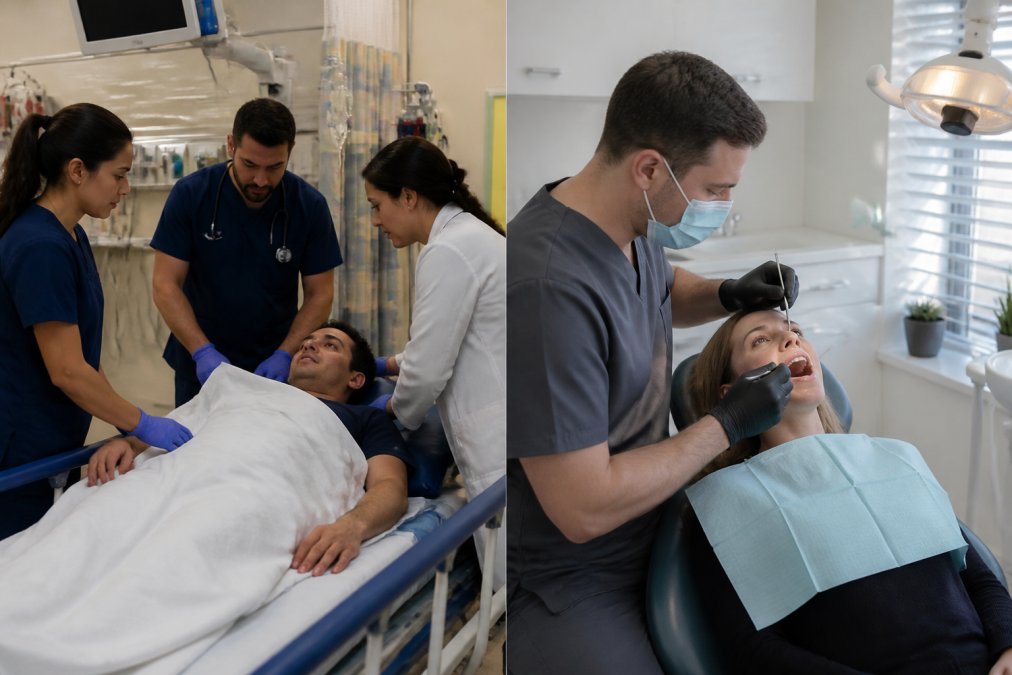
An emergency room becomes necessary when your dental emergency involves trauma to the face or jaw that might involve broken bones, severe bleeding that won’t stop, or signs of serious infection like facial swelling, fever, or difficulty breathing or swallowing. An ER can stabilize life-threatening conditions, manage severe bleeding, and evaluate for fractures.
If you have a knocked-out tooth with no facial trauma, an emergency dentist is appropriate. If you have a knocked-out tooth plus a suspected broken jaw, the ER is your first stop. Many ERs have limited ability to treat the actual dental problem and will likely refer you to an emergency dentist for definitive care anyway.
ER visits typically cost substantially more than emergency dental visits. If your emergency is purely dental, an emergency dentist provides better care at lower cost. Emergency dentists often have same-day or same-evening appointments, providing faster relief than waiting in an ER.
How to Manage Emergency Dental Costs
Managing the financial impact of emergency dental care begins before the emergency happens.
Establish a relationship with a dental provider who offers emergency services. Knowing where to go and having an existing relationship means you’ll likely get faster care and may have established payment arrangements. Ask about their emergency fees and payment options when you first visit for routine care.
If you have dental insurance, understand your emergency coverage before you need it. Know whether emergency extractions are covered differently than emergency root canals and whether out-of-network emergency dentists are covered.
For uninsured patients, ask about payment plans before treatment begins. Many practices offer interest-free plans where you pay a portion upfront and the remainder over several months.
Understand that different treatment options have different costs. Ask your emergency dentist to explain the options available for your specific problem and what each costs. Sometimes a tooth-preserving option like root canal therapy costs more initially than extraction, but extraction creates future costs for replacement.
If cost is genuinely prohibitive, discuss this honestly with your dentist. They may be able to prioritize stabilizing the emergency and managing pain first, with more definitive treatment planned for when you can afford it.
Some employers offer dental benefits through their health plans. Check whether your employer offers any dental coverage or discount programs.
Prevention remains the most cost-effective approach. Regular dental checkups and cleanings catch problems early before they become emergencies. Good oral hygiene and limiting sugary foods reduce your risk of emergencies significantly. At Sendero Dental Studio, we emphasize preventive care because preventing emergencies is far more cost-effective than treating them.
Conclusion
The answer to whether emergency dental care is worth the cost is unequivocally yes. The immediate cost of emergency care is invariably lower than the cascading costs of untreated dental problems, additional procedures, tooth loss, bone loss, and systemic health complications. Addressing a dental emergency promptly preserves your natural teeth, prevents infection from spreading, and protects your overall health.
When you’re facing a dental emergency, Sendero Dental Studio provides same-day emergency care with advanced diagnostic imaging, pain management, and tooth-preserving treatment options when possible. Our team understands that emergencies are stressful and costly, which is why we offer transparent pricing, flexible payment plans, and a commitment to treating uninsured patients with the same comprehensive care we provide everyone. Request your emergency appointment today, prompt care now prevents far more expensive problems later.
Frequently Asked Questions
What situations qualify as a dental emergency?
A dental emergency includes severe toothache pain, knocked-out teeth, cracked or broken teeth, loose teeth from trauma, signs of a dental abscess, uncontrolled bleeding, or jaw injuries. Any condition causing significant pain, swelling, or risk of infection warrants immediate care. Contact a dentist right away if you experience these symptoms to prevent complications.
What if I have a dental emergency but no money?
Many dental offices offer payment plans or financing options for uninsured patients. Some practices provide emergency dental care without insurance by spreading costs across multiple visits. Dental schools and community health centers may offer reduced-cost emergency care. Ask your dentist about available options before treatment, most practices work with patients to find affordable solutions.
How can I minimize the cost of an emergency dental visit?
Seek care promptly to prevent complications that require more expensive treatment. Discuss payment plans upfront. If uninsured, inquire about discount programs or financing options. Prevent future emergencies through regular checkups and good oral hygiene. Quick intervention on a cracked tooth costs far less than waiting for an infection requiring extraction or root canal therapy.
Will the emergency room pull a tooth if it’s infected?
Emergency rooms typically manage pain and infection with antibiotics but rarely perform tooth extraction. They focus on life-threatening conditions like severe infections spreading to the jaw or airway. For actual tooth removal or specialized dental care, you need an an emergency dentist. The ER can stabilize the situation and refer you to dental care, but extraction should happen at a dental office where proper technique and follow-up care are available.
This article was written using GrandRanker